Reference checks that actually happen.
Upload your candidates. RefCheck collects their references, then an AI interviewer conducts each reference call in the reference’s own browser — disclosed up front, recorded with their consent. You read the evidence.
You pay per completed call. Nothing else.
Or be the reference yourself →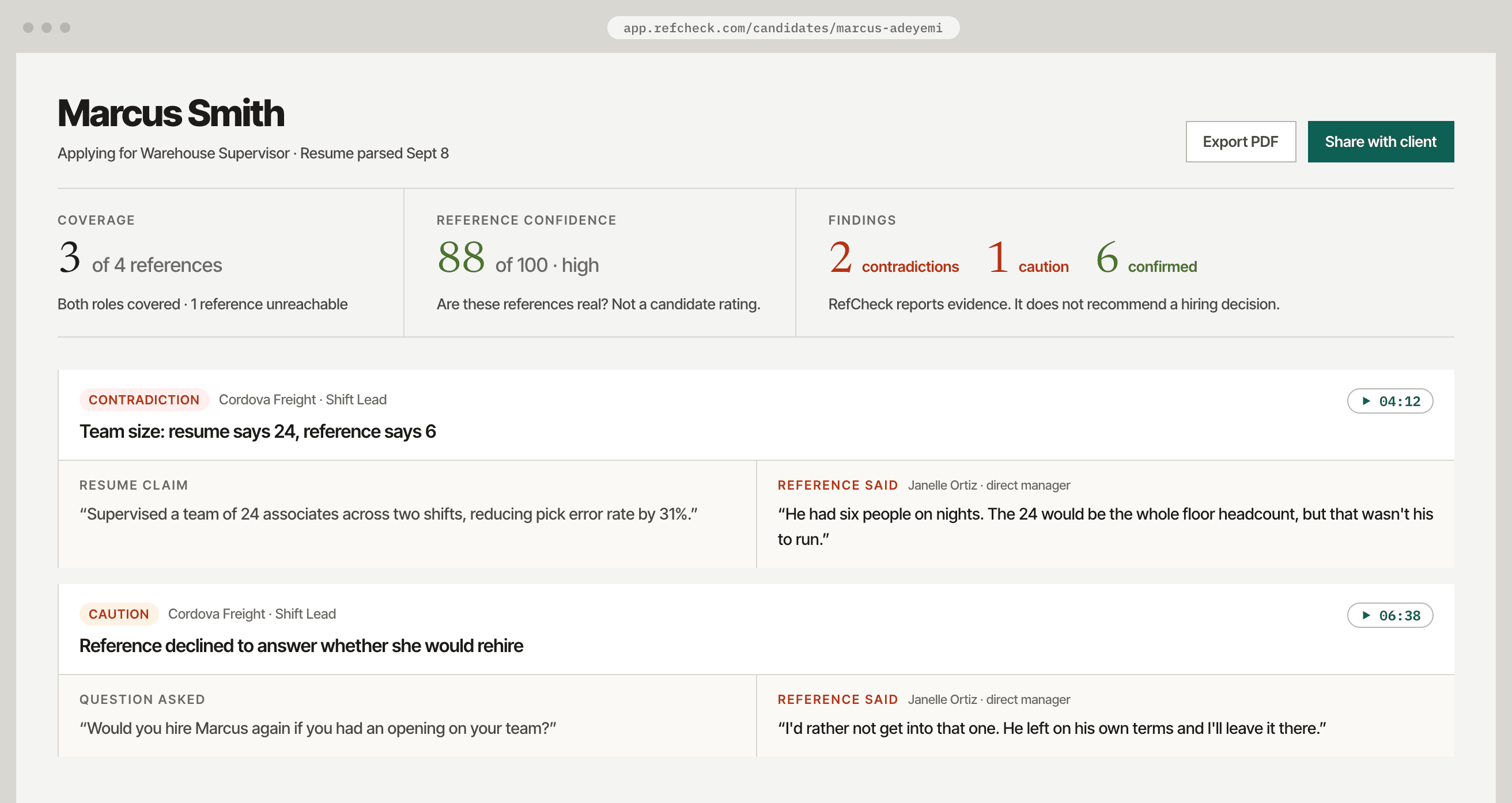
Four steps. You’re involved in one of them.
Reference checks die from latency, not from difficulty. Every handoff we remove is a day you get back.
Upload the batch
A CSV of candidates, their resumes, and the JD. We match resumes to rows, parse each one into checkable claims, and pick the two most recent completed roles.
They name references
One link, two minutes, on their phone. We nudge at 24 and 72 hours and tell you when someone has stalled, so nobody quietly falls out of the batch.
An AI interviews them
They answer out loud in their browser, or take a phone call instead. The agent discloses that it is an AI, gets recording consent before anything else, and asks questions drawn from that candidate's own resume.
You read the evidence
The report goes live from the first completed call. Every line is one click from the moment in the recording that supports it.
They’re told it’s an AI before they say a word.
The interview runs in the reference’s own browser — no app, no dial-in, no slot to pick. Disclosure, consent and the deletion date are all on the first screen.
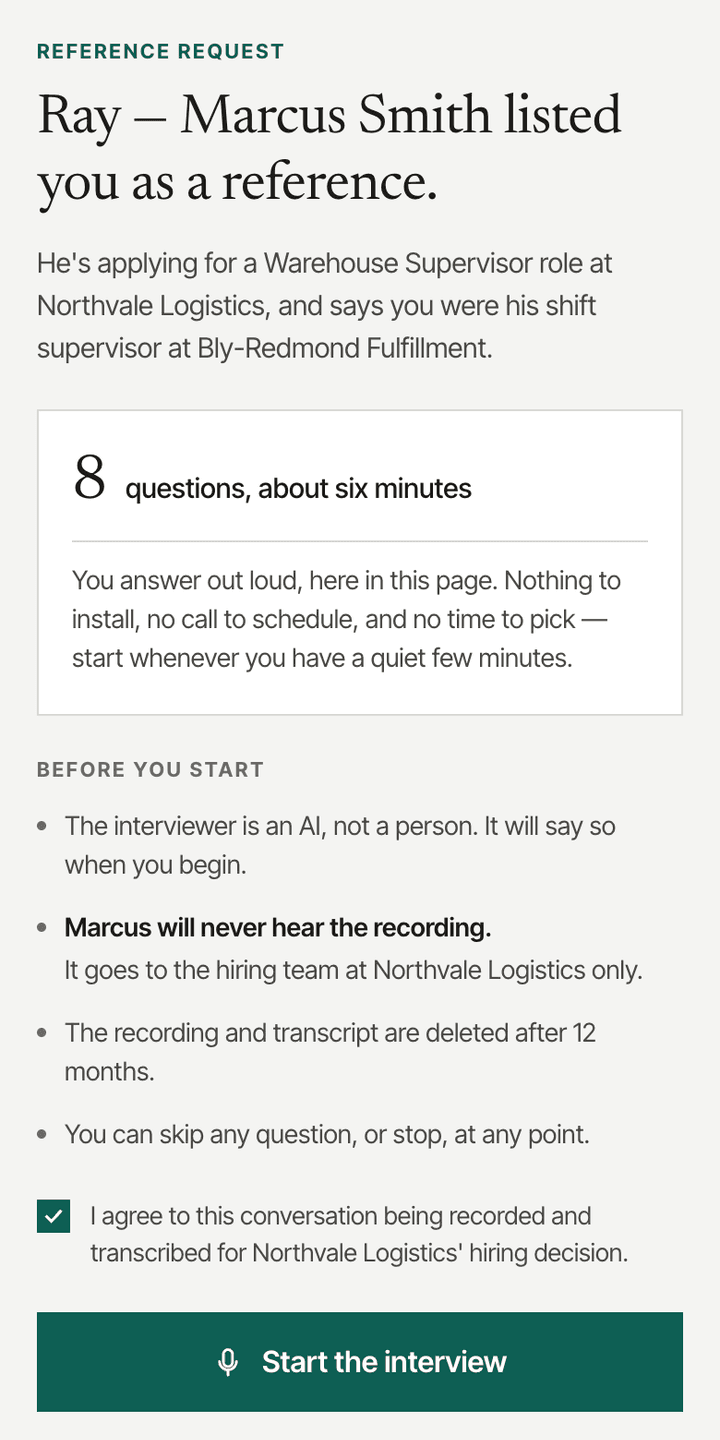
The invitation
Who is asking, how long it takes, and that the interviewer is an AI rather than a person. Nothing starts until they tick the consent box.
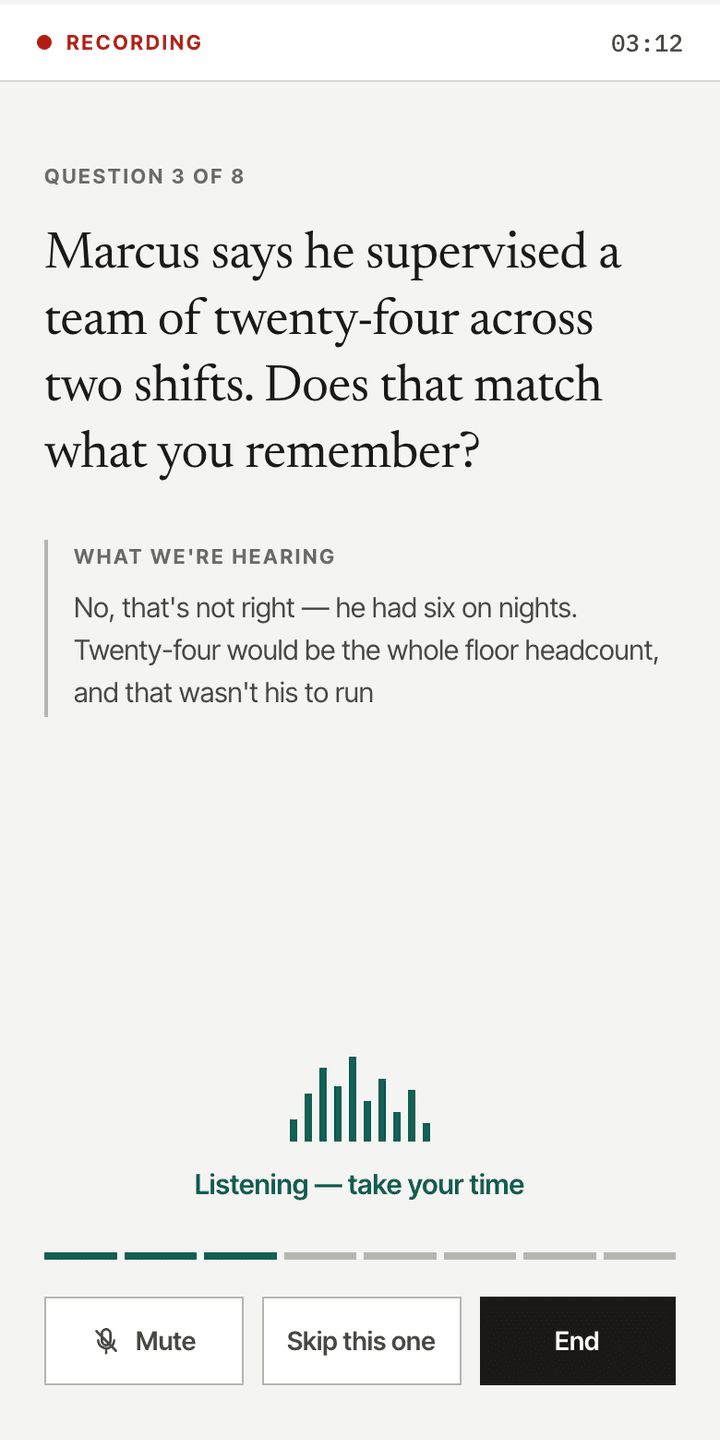
The interview
The agent says out loud that it is an AI, then works through questions drawn from that candidate's own resume. The reference sees what is being heard, and can skip any question or stop.
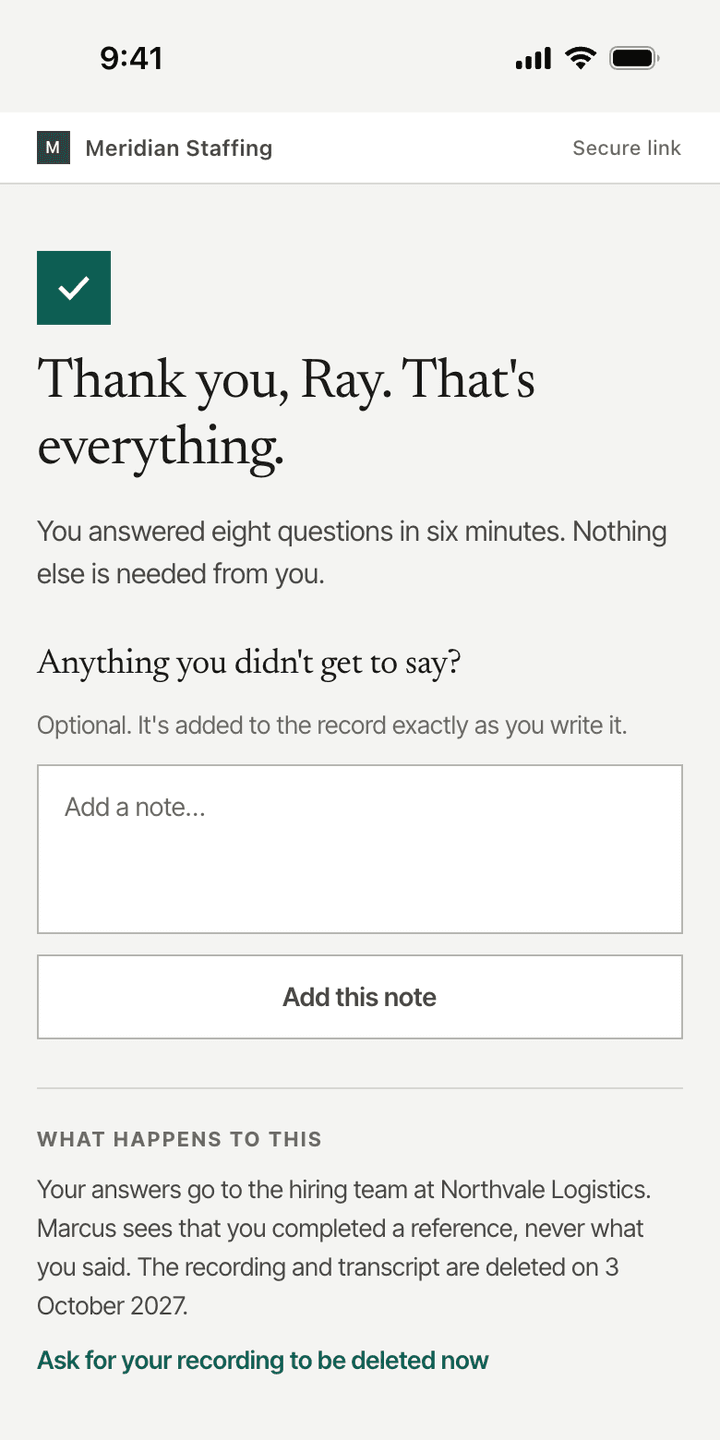
Afterwards
Where the answers go, that the candidate sees only that a reference was completed, and the date the recording is deleted. They can ask for it to be deleted sooner.
A reference who would rather not do this never has to. Every invitation offers a phone call with the same agent, or a written questionnaire instead — and an unreachable reference is reported on the candidate’s page, not quietly dropped.
Be the reference. Then read the report.
A real interview with the same agent, about a candidate who doesn’t exist. Ninety seconds, four questions, nothing stored.
You’re Dana Whitfield, and you managed Marcus for two years.
He’s applying for a Warehouse Supervisor role and listed you as a reference. Answer however you like — these are just your notes.
Ready when you are.
Your browser will ask to use the microphone.
You’ll be talking to an AI, and it says so before the first question. This runs in your browser, the audio is never written to disk, and the transcript disappears when you close the tab. Marcus Smith is not a real person.
Candidates pick their own references.
Which means nothing stops someone handing you a friend’s mobile number. Every reference-checking tool has this problem. Most of them don’t mention it.
We score eight signals on every reference and put the number where you can’t miss it — work-email domain, carrier line type and age, whether they confirmed the dates and site on the call, how specific their answers actually were, and how many other candidates named the same person this month.
A low score never blocks a call. It just means you find out before you make an offer, not after.
Both calls happened. Both are on the report. Only one of them should carry weight.
We don’t give the candidate a score.
It would be the easiest thing to build and the easiest thing to sell. A single number out of a hundred, and a hiring manager who never reads past it.
Reference calls surface things a number cannot hold: a manager who corrects a team size without any malice, one who goes quiet on a rehire question, two who independently describe the same unprompted act. Flattening that into 74/100 destroys exactly the information you were paying for.
So the report gives you three things that don’t average together, and the evidence behind each one.
How much of the check actually happened
Including the references we never reached. An unreachable reference is reported, not quietly dropped.
Whether these references are real people
A fraud signal about the reference. Never a rating of the candidate.
What was said, ranked by how much it matters
Contradictions, cautions, and praise — each paired with the resume claim and a timestamp into the recording.
Your name on it. Not ours.
Candidates and references only ever see your agency. Every batch is scoped to a client, and so is every permission.
White-labelled end to end
Your sending domain, your name on the call. The reference hears your agency introduced, never a vendor they've never heard of.
One check, several submissions
Placing the same candidate with three clients shouldn't mean calling their manager three times. Completed checks are reusable for 90 days, and the report says so.
References aren't a resource to burn
Contacts are deduplicated across every client, rate-limited, and honour a single global do-not-call list. Ask once, and we won't ask again.
Pay for calls, not seats you don't fill
A credit is consumed by a completed call. Voicemails, unreachable references and written fallbacks cost nothing, and you see the estimate before you launch.
Someone is doing you a favour on their own time.
It says what it is
The agent discloses that it's an AI, on whose behalf it's calling, and that the call is recorded — then waits for an explicit yes before asking anything.
It takes no for an answer
Refuse the recording and the call ends politely with a written form instead. No persuading, no proceeding anyway, no recording kept.
It never asks what it shouldn't
Age, health, family status, religion, origin, immigration status. If a reference volunteers one, it's withheld from the report and excluded from every finding.
It doesn't interrogate
Follow-ups exist to clear up ambiguity, never to apply pressure. If a reference can only confirm dates and title, that's policy — and it's labelled as policy, not evasion.
Run your next batch without booking a single call.
Bring one requisition. We’ll run the references end to end and you can decide from the report.